

Welcome to 2026. The hiring game has been rewritten.
Recruiters in 2026 have more dashboards than Formula 1 drivers. Their inboxes hum with candidate summaries written by bots. Job seekers casually submit résumés crafted by AI that could probably pass the Turing test.
The question isn’t whether AI is coming for recruiting. It’s that it’s already unpacked its bags and started running the meetings.
As Lúcio Neto from TechTeems puts it: “There is no turning back from where we are with this technology. It allows recruitment to be faster and more precise, so I would say it is already indispensable.”

So what does 2026 actually look like for hiring teams, candidates, and the increasingly caffeinated people trying to keep it all ethical? Here’s the field guide.
1. Expect AI to do the boring stuff (and some of the fun stuff)
By now, 91% of employers use AI somewhere in their hiring process. Sourcing? Automated. Screening? Instant. Outreach? Ghostwritten by GPT.
But Neto points out a truth everyone forgets: “At the end of the day, it is still just a tool. Recruitment remains a human-centered process. A human still reviews the final shortlist and curates the best options.”
That’s right — the robot may tee it up, but a real person still swings.
The recruiters who thrive in 2026 aren’t fighting automation; they’re choreographing it. They’re the DJs of data — mixing signals, tone, and timing into something that feels personal even when it’s algorithmically mass-produced.
2. Expect bias to be rebranded as ‘data drift’
Ethical AI was the buzzword of 2024. By 2026, it’s a department — and still messy as hell.
“Ethical AI is still a broad and developing topic, not only in recruitment but in every real-world application of this technology,” Neto says. “The fact that people are openly discussing bias is a good sign. This is not going unnoticed.”
Translation: it’s progress, but don’t pop champagne yet. Bias hasn’t disappeared.
“Human recruiters also have bias,” he adds. “We get tired, distracted or influenced by context. You might evaluate a candidate differently at the end of a stressful day than you would in the morning after good news.”
AI might even out some of those fluctuations, but it’s not immune. The future recruiter’s job isn’t to eliminate bias — it’s to recognize which version they’re dealing with today: human or synthetic.
3. Expect job interviews to survive the singularity
For all the hype, the sacred interview remains untouched.
“There is no replacement for a job interview with a real person, as long as humans are still working with humans,” Neto says. “People will still want to meet before hiring. I do not think a manager would hire someone after a fully automated process and meet them for the first time on their first day.”
If anything, interviews will get more theatrical. Picture hybrid panels, emotion-detection overlays, virtual handshake simulations. But in the end, it’s still two humans trying to figure out if they can tolerate each other for 40 hours a week.
“Cultural fit and interpersonal connection are deeply human elements that AI cannot replicate.”
That line should be printed on every recruiter’s monitor.
4. Expect fewer specialists — and a lot more generalists
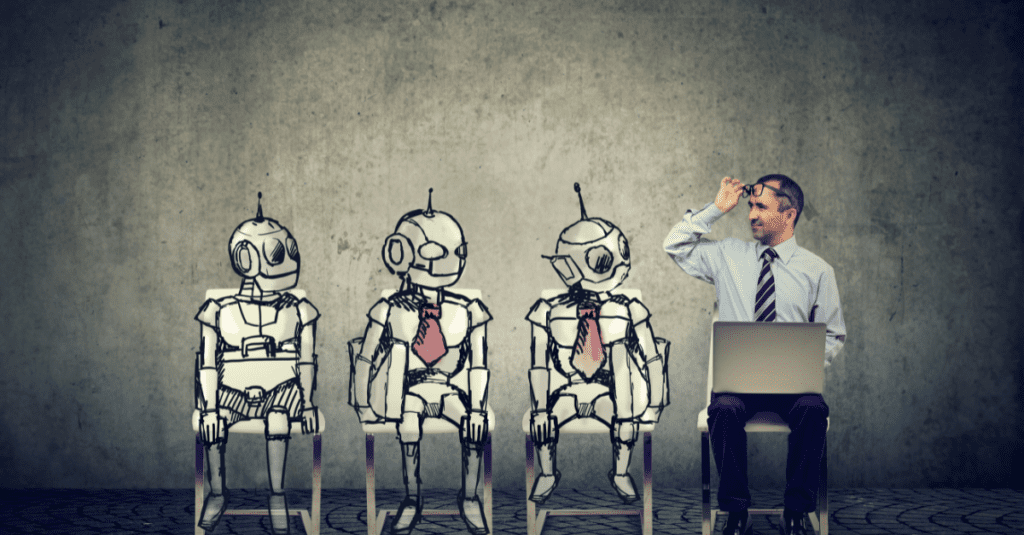
The traditional “career ladder” is now a trampoline.
“We will likely need fewer people, and those people will need to be more versatile, less specialized but with a broader understanding of business and how to get things done,” Neto predicts.
The org chart of 2026 looks flatter and weirder — think four humans and 50 AI agents.
“That could lead to leaner and more efficient companies, maybe four or five people doing the work that currently takes a hundred,” he says.
Those humans won’t be cogs. They’ll be conductors, orchestrating the chaos — half strategist, half technologist, fully allergic to inefficiency.
5. Expect recruiting to feel more like dating apps
If AI can predict compatibility, why not chemistry? In 2026, recruiters rely on behavioral scoring, micro-interaction tracking and pattern recognition that can tell you who’s likely to ghost before they even schedule an interview.
The résumé is dying. The personal brand is currency. Everyone’s profile looks like a dating app bio written by LinkedIn’s evil twin.
AI outreach is hyper-personalized to the point of absurdity (“We noticed you tweeted about TypeScript and oat milk lattes — want to join our dev team?”).
Recruiters, meanwhile, are mastering the art of empathy at scale. Neto calls it keeping “the human touch and the sense of empathy that make this industry work.”
6. Expect the global brain drain to go nuclear
“That is already happening in the AI field between companies and even countries,” Neto says. “We are seeing contracts with compensation levels comparable to NBA athletes for top AI engineers.”
By 2026, the war for talent is planetary. Countries are competing for machine-learning minds the way sports teams bid for all-stars.
At the same time, Neto says entry-level openings are evaporating. “We are seeing fewer entry-level openings across the tech industry. Whether that is because of AI or other economic and social factors is still up for debate.”
The outcome? A bifurcated world: a handful of über-paid AI whisperers and a sea of freelancers hustling across platforms, patching together digital gigs like quilt squares.
7. Expect optimism (with a seatbelt)
Despite the chaos, Neto refuses to go dystopian. “I am an optimist by nature, and I believe technology is the best engine we have to drive change, hopefully more for good than for bad. Still, history reminds us that progress is not always linear, and sometimes the bad can outweigh the good. That is why I would call myself a cautious optimist.”
Recruiting in 2026 will be faster, stranger and more dependent on human nuance than ever. The irony? The more automated we become, the more empathy matters.
Neto sums it up perfectly: “Right now, a smaller recruitment agency can achieve much more and deliver far greater impact with the same structure than it ever could even five years ago.”
That’s the story of 2026 in one sentence — leaner, louder and powered by people who know how to work with machines instead of against them.
The year of the human API

In 2026, the best recruiters aren’t gatekeepers. They’re translators — people who can turn data into decisions, empathy into efficiency and machine output into real connection.
That’s the new edge. That’s the Human API.
Until then, maybe just… be nice to your AI. You never know who’ll be reviewing your résumé next.